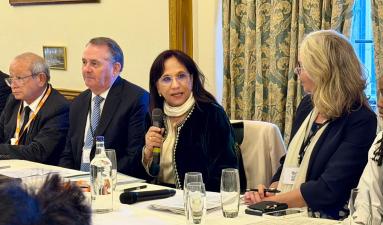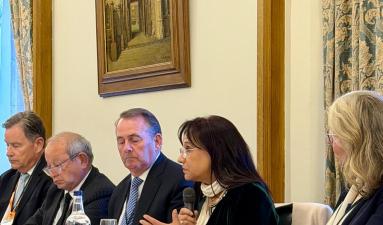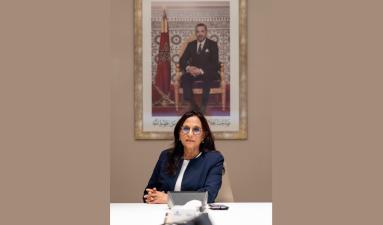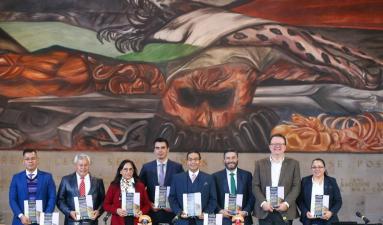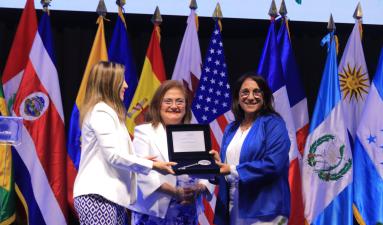
Ms. Amina Bouayach, Chairperson of Morocco’s National Human Rights Council (CNDH) and of the Global Alliance of National Human Rights Institutions (GANHRI), received the 2025 Order of Professional Merit In recognition of her unwavering commitment to protecting and promoting human rights at both national and international levels. She was awarded the distinction by the Scientific Committee of the 8th International Conference on Human Rights and Electoral Rights. She
The order was presented during the Madrid conference in October 2025, organized by the Rey Juan Carlos University of Madrid and the Leader Academy for Advanced Training, with support from several European institutions, including the University of Rzeszów (Bologna), the University of Las Palmas de Gran Canaria (Spain), and the Electoral Tribunal of the Federal Judiciary of Mexico.
The Order of Professional Merit is a prestigious honor granted by academics, experts, and judges to recognize outstanding careers in defending human rights. Previous recipients include Mr. Roberto de Caldas, former President of the Inter-American Court of Human Rights, and Ms. Raquel Caballero, a human rights defender in El Salvador.
In her closing remarks, Ms. Bouayach expressed her appreciation to the scientific committee, describing the award as a tribute to all human rights defenders worldwide and their ongoing struggle to uphold human dignity, justice, and equality.
The GANHRI Chairperson highlighted that while elections reflect the will of the people, they alone are insufficient to guarantee the protection of rights and freedoms. She emphasized that “democracy is not merely the act of voting, but an ongoing process in which public policies are built on the foundations of human rights.”
She further noted that elections do not automatically ensure human rights, stating that “true democracy is based on strong institutions, a deeply rooted culture of rights, and continuous civic participation.”
Reflecting on contemporary social transformations, Ms. Bouayach observed that demands for rights and forms of expression are increasingly taking place outside traditional channels such as political parties, unions, and youth associations. Citizens are turning to new forms of organization and participation, especially through digital platforms and self-mobilization.
She noted that this shift reflects both a decline in trust in traditional channels and a search for alternative spaces to express social demands and protect fundamental rights.
Addressing current challenges, she spoke on the impact of artificial intelligence and new technologies on electoral systems and political participation. She stressed that innovation should go beyond technological tools to transform the electoral system into a true space for citizenship and active participation, rather than merely a mechanism for representation.
Ms. Bouayach also underscored the central role of NHRIs in accompanying these societal transformations and safeguarding rights in a rapidly changing world. She called for deepening dialogue among researchers, human rights actors, and institutions to respond effectively to the challenges posed by the digital revolution and profound social change.


Read more