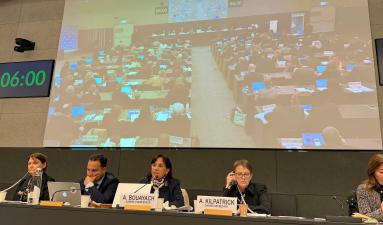
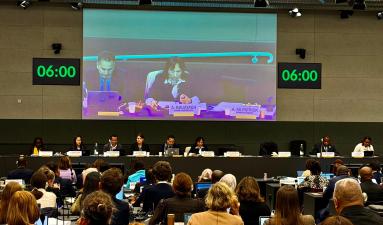
At a regional forum on the Right to Redress and the Rehabilitation of Torture Victims in the Middle East and North Africa, held in Beirut, Ms. Amina Bouayach, Chairperson of the Global Alliance of National Human Rights Institutions (GANHRI) and of Morocco’s National Human Rights Council (CNDH), emphasized that the rehabilitation of torture victims, as well as victims of all serious human rights violations, and transitional justice processes, are a top priority in the region today. She noted that these efforts “cannot be separated from any genuine pursuit of stability, justice, and peace” in a region still marked by tensions, conflicts, and wars.
Speaking at the forum, organized by the Restart Center in partnership with the UN Office of the High Commissioner for Human Rights on 10–11 July 2025, Ms. Bouayach explained that transitional justice is not limited to legal procedures or technical mechanisms. It also involves “deep political, ethical, and human pathways that allow societies to confront their painful past and build a new social fabric based on truth, accountability, and fairness.” She highlighted that the region “has endured a history weighed down by violence and serious human rights violations,” a legacy that demands courage and clear political will to address.
Ms. Bouayach stressed that transitional justice must be victim-centered, noting that “their suffering, needs, and participation in achieving redress are what give these processes their true meaning.” She added that rehabilitating victims is not only a legal or political duty but also a profound moral and human commitment.
In this context, Ms. Bouayach stressed: “Zero tolerance for torture is an objective that represents a clear break with the past and a means of supporting the rehabilitation of victims, ensuring that others do not endure the same fate. This goal and promise,” she added, “must remain a guiding principle for states and all actors, just as it is for human rights defenders.”
Ms. Bouayach also stressed the need for collective reflection on ways to achieve justice and reparation, calling for active engagement and dialogue on regional mechanisms to ensure both. She emphasized that transitional justice is central to the profound transformations the region is undergoing, which demand bold, independent, and transparent approaches that break with violence and lay the foundations for a just and lasting peace.
As Chairperson of an alliance of 118 NHRIs worldwide, and Chairperson of an NHRI that played a key role in one of the region’s first transitional justice experiences, which was also among the pioneering TJ journeys globally, Ms. Bouayach stressed the importance of investing in transitional justice as “it offers a rare opportunity to rebuild trust and reshape the relationship between the state and society.”
On the subject of torture, she underlined that its prohibition is a peremptory norm of international human rights law, allowing no exceptions under any circumstances. “Putting this principle into practice requires a coherent legislative framework, independent oversight institutions, and comprehensive preventive measures to firmly establish a culture of rights and freedoms,” Ms. Bouayach added.
The CNDH Chairperson emphasized that the discussion on transitional justice goes beyond the application of human rights standards, representing a deeper philosophical and legal reflection on human dignity and the guarantees needed to build a society that protects the rights of all its members, a perspective that “regrettably does not receive the attention it deserves in the public policies and reform programs of many countries.”
In closing, Ms. Bouayach called for a true collective commitment across the region to restore dignity to victims, develop victim-centered justice models, and open new pathways toward peaceful transitions and sustainable social reconciliation.


Read more