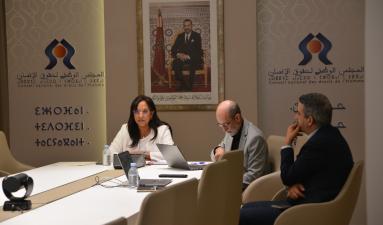
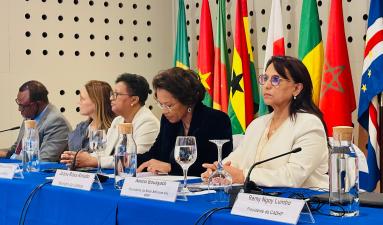
Ms. Amina Bouayach, Chairperson of the National Human Rights Council (CNDH), presented key aspects of Morocco's transitional justice (TJ) experience, highlighting the most distinctive features of the Equity and Reconciliation Commission, during her participation in a regional forum in Beirut, Lebanon, on July 10–11, 2025, themed “Equity and Rehabilitation for Victims of Torture in the Middle East and North Africa.”
In her remarks, Ms. Bouayach emphasized that the establishment of the Commission in 2004 was the culmination of a long journey of civil activism and advocacy that began in the early 1990s. It marked a crucial step toward democratic transition, the consolidation of the rule of law, and a break from past practices that had led to serious human rights violations.
The CNDH Chairperson emphasized that, through a free national will, Morocco chose to revisit its collective memory, not only for documentation but also to consciously confront its past and use it to build a future rooted in reconciliation, dignity, and justice. She explained that the Moroccan experience was founded on societal dialogue and political engagement, addressing past violations without denying responsibility. The process focused on transforming the pain of the past into lessons that foster broader societal participation.
In this context, the initiative was a sovereign effort to confront the past: uncovering the truth, assuming state responsibility, and compensating victims while redressing grievances. This approach took place within a political environment not marked by armed conflict, but rather by a voluntary and sovereign decision to rebuild trust and establish dignity as a cornerstone of reform.
Ms. Bouayach highlighted that Morocco did not adopt ready-made models of transitional justice. Instead, it developed approaches tailored to the national context, fostering solutions through cooperation between the state and society. This allowed for the implementation of mechanisms for redress, recognition, reform, and guarantees of non-recurrence in a consensual and context-sensitive manner.
She further noted that the process involved a careful structuring of the stages of truth-seeking, reparations, and reform, contributing to the establishment of a new social contract. This contract aims not only to safeguard human dignity but also to shift the focus from merely addressing past violations to proactively preventing future abuses through constitutional, institutional, and legislative measures.
Regarding legal and institutional developments, Ms. Bouayach affirmed that Morocco has adopted laws explicitly criminalizing torture and ensuring accountability for perpetrators. She also noted the establishment of the National Mechanism for the Prevention of Torture within the CNDH, in line with the recommendations of the Equity and Reconciliation Commission and Morocco’s international obligations, particularly the Optional Protocol to the Convention against Torture.
Ms. Bouayach concluded by emphasizing that Morocco's transitional justice experience is grounded in the principles of equity, where truth-seeking and reparations are not ends in themselves but part of a broader process aimed at reinforcing the role of institutions and consolidating the rule of law.


Read more