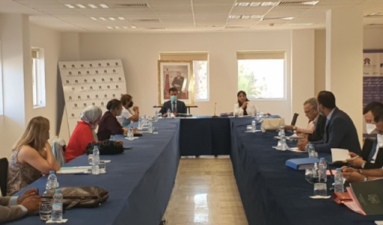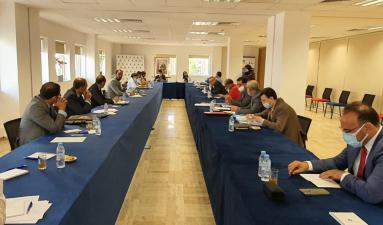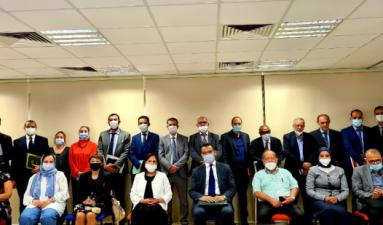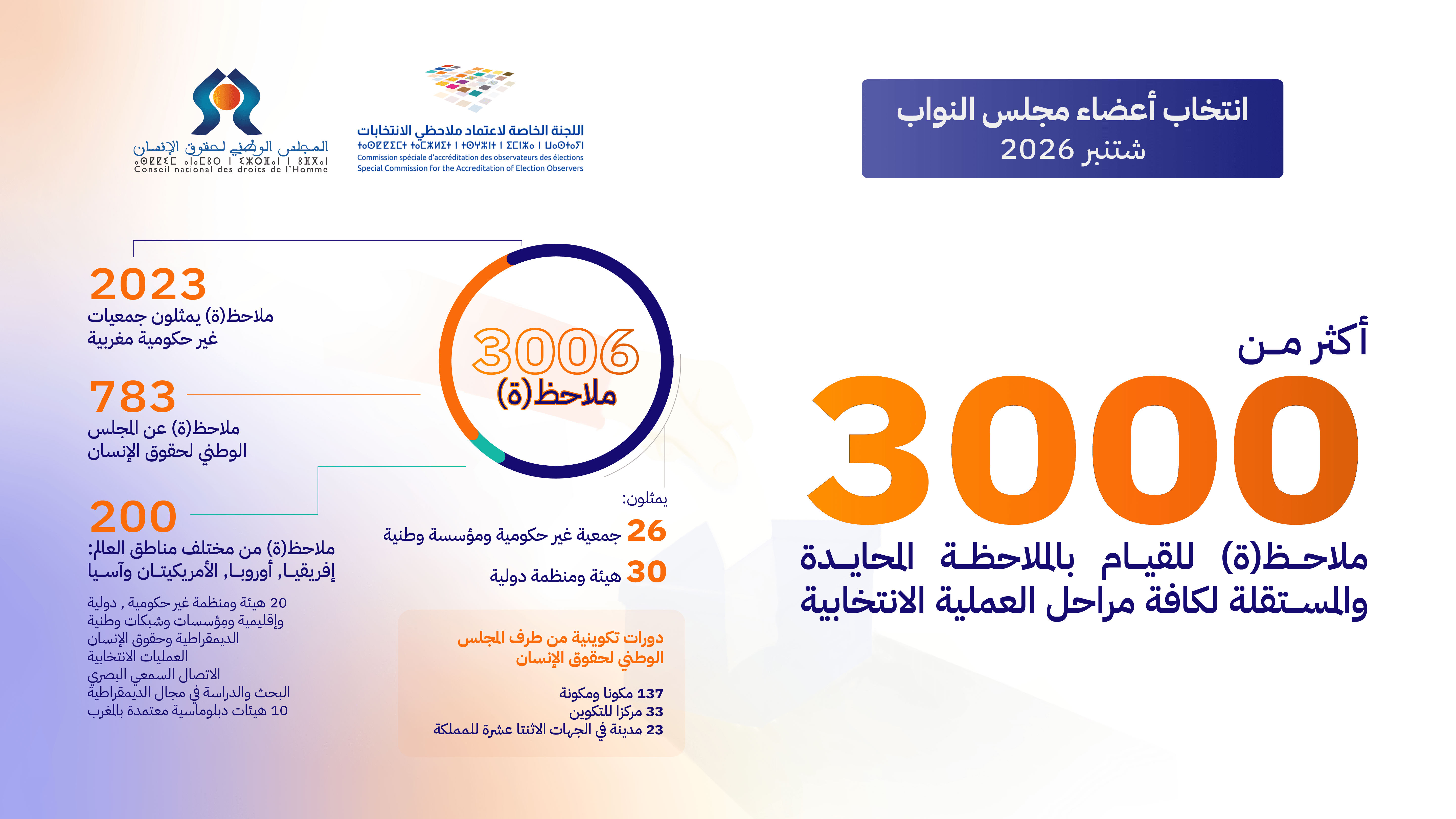
At two meetings held on 4 and 7 September at the National Human Rights Council (CNDH) headquarters in Rabat, the Special Committee for the Accreditation of Election Observers, chaired by Ms. Amina Bouayach, accredited 26 NGOs and one national institution, as well as 30 international bodies and organisations, to deploy the observers.
Of the total, 783 observers will represent the CNDH, while 2,023 will represent Moroccan NGOs. They will independently and impartially observe the various stages of the electoral process, in accordance with the relevant legal and regulatory provisions.
The legislative elections will also be observed by delegations from 20 international and regional NGOs and bodies, as well as national institutions and networks working in the fields of democracy, human rights, electoral processes, audiovisual communication, and research and studies on democracy. Ten diplomatic missions accredited in Morocco will also take part.
Around 200 observers representing these bodies and organisations will come from across Africa, Europe, the Americas and Asia. From 20 September, the CNDH will organise briefing sessions for the participating delegations on Morocco’s legal framework governing elections and election observation, ahead of their deployment across the Kingdom’s 12 regions.
The Parliamentary Assembly of the Council of Europe (PACE) had previously deployed a pre-election mission from 31 August to 2 September to observe preparations for the electoral process. The mission met with representatives of several government departments and national institutions, as well as civil society organisations, media outlets and diplomatic missions accredited in Morocco.
As preparations for election observation continue, Ms. Bouayach, Chair of the Special Committee, reiterated that accreditation for independent and impartial election observation was granted on the basis of full compliance by all applicants with the legal and regulatory requirements governing election observation, as well as with the fundamental principles and rules applicable to the process.
She noted that particular attention was given during the review of applications to nominations reflecting geographical and cultural diversity and taking gender into account. The Committee also considered nominations from associations working to protect and promote the rights of persons with disabilities, with a view to ensuring greater diversity and inclusiveness among independent and impartial observers.
Ms. Bouayach also reaffirmed the importance of accredited observers carrying out their duties independently and impartially and complying with the relevant legal and regulatory provisions, as well as the Code of Ethics for Independent and Impartial Election Observation. She noted, in this regard, the growing interest among international and regional organisations from Africa, Europe, Latin America, the United States and the Arab region in observing elections.
Established under Law No. 30.11 on the conditions and procedures for independent and impartial election observation, the Special Committee brings together representatives of government departments, constitutional institutions and civil society organisations and is chaired by the CNDH. It is in charge of receiving and reviewing accreditation applications, deciding on them, and issuing accreditation cards and badges to accredited observers. The Committee will continue to follow up on the observation process and exercise its mandate to ensure the conditions necessary for independent and impartial election observation.
As part of preparations for the observation process, the CNDH organised several training sessions in June for election-observer trainers, benefiting 137 trainers. These were followed by regional training sessions for 1313 CNDH observers and observers from other NGOs accredited by the Committee. The sessions were held at 33 training centres in 23 cities across the Kingdom’s 12 regions.


Read more