
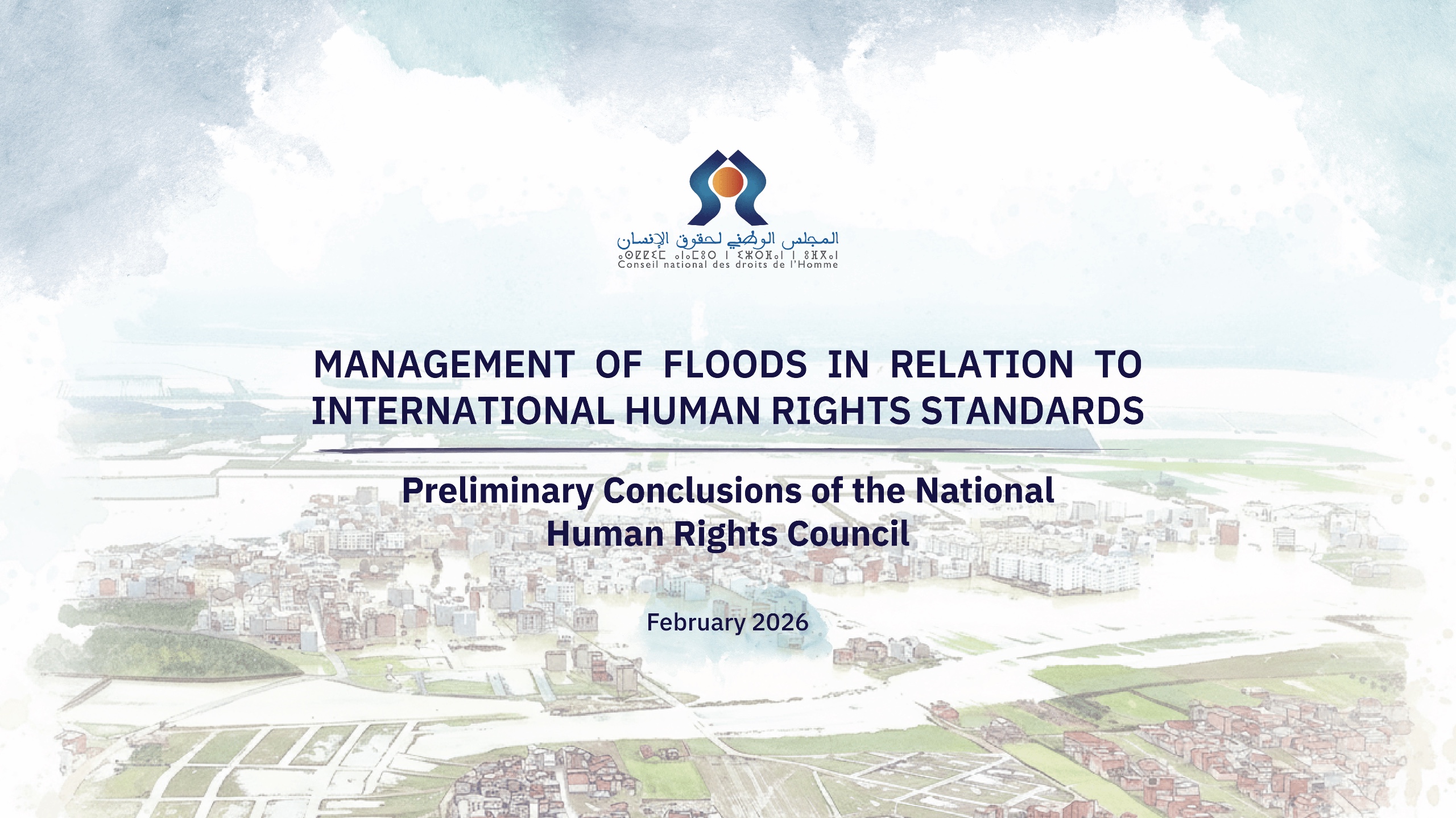
The National Human Rights Council (CNDH) welcomes the gradual return of residents, who had been evacuated from flood-affected areas to safer locations, to their places of residence, following rehabilitation efforts and the restoration of conditions consistent with human dignity. The CNDH further notes with appreciation the measures taken by public authorities to facilitate such return through coordinated multidimensional logistical arrangements.
The CNDH has closely monitored the floods that affected several regions during January and February 2026, which resulted in significant material damage, including the submersion of approximately 110,000 hectares, damage to housing, infrastructure, and private property and disruption of livelihoods.
In conducting its assessment, the CNDH drew upon its previous work, including its thematic report issued in June 2024 entitled Protecting Human Rights in the Context of the Atlas Earthquake: Recommendations for Implementing a Human Rights-Based Approach to Strengthen Disaster Preparedness. The report was informed by surveys and consultations with various stakeholders, including civil society organizations.
The present assessment is guided by relevant international standards governing effective emergency response, including coordinating humanitarian assistance, activating monitoring, oversight, and protection mechanisms, and organizing recovery and reconstruction efforts. All of this shall be guided by a comprehensive human-rights based approach to natural disaster response. In particular, it aligns with the Sendai Framework for Disaster Risk Reduction (2015-2030) , adopted by the United Nations Office for Disaster Risk Reduction.
These standards underscore the need to ensure proactive preparedness, including strengthening readiness and maintaining regional strategic reserves. They also stress that evacuations must remain temporary and respect people’s dignity, privacy, and social ties. At the same time, they warn against prolonged relocation in housing that fails to meet adequate living standards.
The standards further highlight the need to guarantee continuity of essential services, especially access to education, in line with UNICEF and UNESCO guidelines, as well as access to basic healthcare services, as defined by the World Health Organization . They also affirm the right to adequate housing and sufficient food, as outlined in General Comment No. 4 of the Committee on Economic, Social and Cultural Rights.
Reconstruction, according to these standards, should be guided by the principle of “Build Back Better” , with a view to strengthening resilience, improving infrastructure and public services, respecting cultural and architectural specificities, integrating environmental considerations, and improving infrastructure and public services. The goal is to enable affected areas to fully recover, restore living conditions that preserve human dignity and promote territorial equity.
PRELIMINARY CONCLUSIONS
The CNDH presents the following preliminary conclusions regarding the management of the floods:
- The CNDH welcomes the rapid mobilization and intervention of public authorities, who effectively anticipated the risks and mobilized rescue teams and equipment and made them available to the residents. The Royal Armed Forces, Royal Gendarmerie, National Police, Civil Protection, Auxiliary Forces, and territorial authorities all played a key role and contributed to the evacuation of affected populations and protection of property in the most severely affected areas, especially in the city of Ksar El Kebir in early February.
- Authorities also ensured free transportation for residents and established temporary shelters and healthcare centers, with special attention given to pregnant women, the elderly, and persons with disabilities;
- The CNDH notes in particular the preventive evacuation of over 180,000 persons in several provinces, particularly Larache, Kenitra, Sidi Kacem, and Sidi Slimane. This was the largest preventive evacuation operation carried out in Morocco in response to a natural disaster. The CNDH considers that these measures contributed significantly to the protection of the right to life and physical integrity in at-risk areas. Only isolated fatalities were reported, mostly involving individuals who underestimated the risks. The CNDH expresses its sincere condolences to the families of the deceased.
- The CNDH notes that residents positively responded to the call to evacuate. The Council commends their cooperation with the local authorities, facilitating their transfer to safe areas in highly organized circumstances, which contributed to supporting protection and response efforts.
- The CNDH highlights that several measures were implemented to ensure the immediate evacuation of residents from flood-affected areas and to provide temporary accommodation facilities for the evacuated persons, across multiple provinces, particularly near the city of Ksar El Kebir, which was the most affected by the floods. However, it also notes that, in a limited number of cases, such facilities did not fully meet international standards relating to adequate housing, including with regard to privacy, access to water and sanitation, and protection from risks.
- The CNDH notes the adoption of emergency measures aimed at ensuring the safety of students and educational personnel. These included the temporary suspension of in-person education in effected and at-risk areas, the provision of online and remote learning, and efforts to gradually resume academic activities in institutions not affected by the disaster. In addition, temporary and innovative measures were adopted in some cases to maintain continuity of education. Efforts were also undertaken to address operational constraints that sometimes hindered the effective implementation of emergency education mechanisms. Particular attention was given to mitigating disparities in the pace of resuming normal education, especially in rural areas.
- The CNDH welcomes the measures taken to ensure access to healthcare services for affected populations, in partnership with specialized civil society organizations. These include:
• Evacuating and relocating pregnant women to centers that have medical supervision, ensuring access to appropriate maternal healthcare services;
• Providing care for older persons and persons with disabilities, including regularly monitoring their health conditions;
• Ensuring continuity of treatment for persons with chronic illnesses;
• Prioritizing patients requiring specialized treatment, including hemodialysis and cancer care;
• Deploying mobile medical teams providing multidisciplinary services. These included general medicine care, obstetric and gynecological services, endocrinology consultations, diabetes and hypertension, cardiovascular care, rheumatology, and mental health services. Ultrasound examinations, consultations, and free medications were provided.
- The CNDH notes the measures taken to ensure the urgent distribution of food and potable water to affected populations, with the active support of institutional and civil society actors. The CNDH further notes the steps taken to address residents’ complaints in certain areas which did not receive sufficient food assistance during the initial stages of the disaster;
- The CNDH notes the active engagement of civil society organizations at both local and national levels in awareness-raising initiatives and in providing support and assistance to affected populations. It highlights the dissemination of early warning information and evacuation calls through various communication channels. This significantly contributed to facilitating evacuations within a short timeframe. The CNDH further notes the circulation of disinformation relating to the floods, including deepfakes that sought to exaggerate or misrepresent facts relating to affected populations, outdated or unrelated images falsely linked to the floods, AI-produced misleading warning messages, etc. The CNDH welcomes the vigilance of relevant stakeholders and their efforts to counter disinformation. Much of the misleading digital content, alleging structural collapses and mismanagement, was primarily disseminated by accounts operating outside Morocco.
- The CNDH commends the Royal Instructions to the Government and the necessary regulatory measures taken. It welcomes the designation of the four most affected provinces (Larache, Kenitra, Sidi Kacem, and Sidi Slimane) as “disaster areas” and the establishment of an assistance and support program for affected populations.
- The CNDH notes the adoption of diversified measures to address the disaster’s consequences. This included rehousing assistance, compensation for loss of income, rehabilitation of damaged homes and small commercial outlets, reconstruction, in-kind assistance, support to urgent activities to ensure urgent and essential services, support to farmers and livestock breeders, investments in rehabilitation of critical infrastructure, including roads, dams, drainage networks, reservoirs, and essential public utility networks.
- The CNDH notes the progress achieved in the development of the “Integrated National Disaster Management Strategy 2030", including measures aimed at strengthening early warning systems, coordination mechanisms at the territorial and regional levels, reviewing and updating the legal framework, establishing logistical platforms, and developing financial compensation mechanisms.
The CNDH considers that the management of the floods reflected a clear and important progress in integrating a human rights-based approach into disaster response and in aligning with international standards. This progress is evident in both the implementation of measures and in the operational expertise in disaster management.
The CNDH notes that the disaster management was a commendable practice, offering an opportunity to develop a national protocol for anticipatory intervention and serve as the foundation of a Moroccan practice in preventive or proactive preparedness. It further considers that declaring the affected areas as "disaster areas" provides an optimal legal framework for addressing the aftermath of disasters, consistent with the human rights-based approach to managing natural disasters by considering affected populations as victims, rather than merely as recipients of aid.
RECOMMENDATIONS
The CNDH calls upon all relevant stakeholders to strengthen disaster preparedness and prevention measures by:
Developing and implementing comprehensive local flood risk management plans that integrate a human rights-based approach and identify the roles and responsibilities of all stakeholders;
Strengthening local early warning systems and ensuring communication with citizens (or affected populations);
Ensuring compliance with urban planning regulations to prevent construction in flood-prone areas;
Reviewing the Government’s strategic vision on climate change adaptation, recognizing that climate risks include both droughts and heavy rainfall and floods. All these elements should be considered in the Government strategies, including tsunamis in the Mediterranean and the Atlantic;
Integrating climate change risks, including droughts and floods, into development and territorial planning policies for the coasts (littoral zones), mountains and oases;
Taking into account vulnerable situations and collapsed housing outside officially designated “disaster areas.”
Link to CNDH's Preliminary Conclusions (Available in Arabic)


