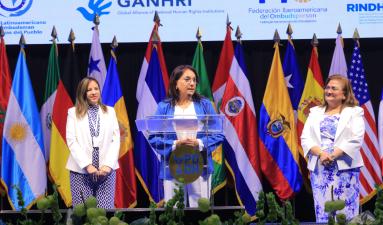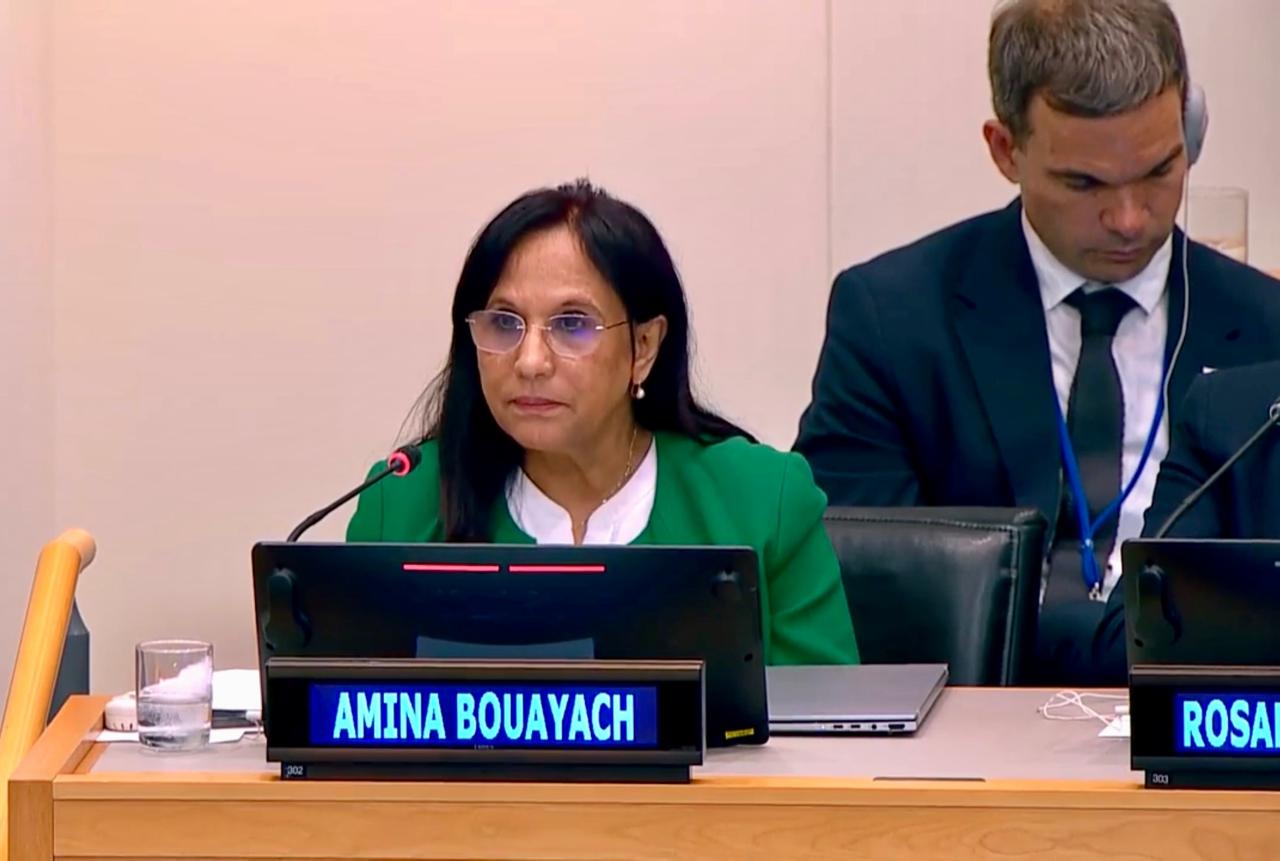
Speaking at a high-level policy debate held in New York City during the second International Migration Review Forum (IMRF) in May 2026, Ms. Amina Bouayach, Chairperson of the National Human Rights Council (CNDH) and of the Global Alliance of National Human Rights Institutions (GANHRI), stressed that migration cannot be treated merely as a political issue or reduced to statistics in international reports. Behind the figures, she stated, are deeply human stories that expose profound shortcomings in the global governance of migration.
Reflecting on the testimonies shared during the forum, she observed that many were “marked by extremely grave human tragedies,” revealing a stark disconnect between international commitments and the lived realities faced by migrants around the world.
As part of her continued advocacy for strengthening the role of national human rights institutions (NHRIs), the CNDH Chairperson underlined the crucial role these bodies play in bridging that gap at the national level. Through their day-to-day work, NHRIs monitor and document violations, support victims, and engage in advocacy with both national authorities and international mechanisms. Through international networks such as GANHRI, they also help ensure that migrants’ concerns reach spaces where policy decisions are made, both nationally and globally.
She added that NHRIs contribute to identifying structural failings, improving monitoring mechanisms, and promoting rights-based approaches to migration governance centered on the protection and advancement of migrants’ rights. In this way, individual cases are not treated as isolated incidents, but become part of a broader conversation on accountability and public policy reform.
The GANHRI Chairperson also highlighted the experience of the CNDH in protecting migrants’ rights and fostering constructive engagement with national stakeholders, while continuing to strengthen international and African cooperation on migration issues. It is worth noting that she also leads the African Working Group on Migration within the Network of African National Human Rights Institutions (NANHRI). In this capacity, the Council has worked closely with the United Nations Committee on Migrant Workers and contributed to regional African initiatives aimed at harmonizing approaches, reinforcing coordination, and strengthening the protection of migrants’ rights across the continent.
She emphasized that centering NHRIs within international monitoring mechanisms “is not optional, but essential,” given the key role these institutions play in promoting accountability and ensuring respect for migrants’ rights.
Concluding her intervention, Ms. Bouayach underscored that migrants must never be reduced to their economic function alone. They are individuals carrying aspirations, hopes, and life projects, often undertaking dangerous journeys in pursuit of dignity and opportunity. "Protecting human rights in the context of migration remains one of the clearest tests of the international community’s commitment to justice, solidarity, and human dignity eight years after the adoption of the Global Compact for Safe, Orderly and Regular Migration in Marrakesh," she concluded.
The session also brought together the Colombian Minister of Foreign Affairs, the EU-Commissioner for Internal Affairs and Migration, representatives of the International Committee of the Red Cross, and the Director-General of the International Organization for Migration, who also serves as Coordinator of the UN Migration Network.


Read more