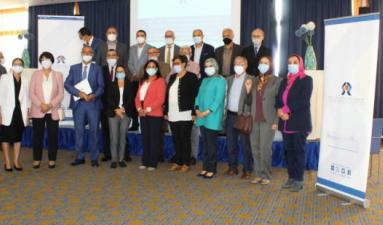
On October 1, 2025, the President of Morocco’s National Human Rights Council (CNDH), Ms. Amina Bouayach, met with the presidents of the Council’s Regional Human Rights Commissions, directors, and chargés de mission, to discuss approaches and mechanisms to strengthen the NHRI’s monitoring, follow-up, and intervention in light of recent youth-led protests in several Moroccan cities.
From the onset of the protest calls, the CNDH deployed teams for on-site monitoring, follow-up, and protection actions at the regional level, through its 12 regional commissions, as well as at the national and digital levels. This also included engaging with local authorities and young people at protest sites.
The CNDH recognizes that the digital space has become fertile ground for freedoms, where new values are created and expressed, providing a framework for youth engagement, participation, and the peaceful exercise of fundamental rights. At the same time, it notes that:
• The youth-led protests, which began peacefully following calls for demonstrations, were in some cases marked (later) by violence. These included inappropriate or disproportionate interventions, as well as acts of stone-throwing, looting, car arson attacks, and the destruction of public and private property.
• The right to peaceful assembly must be protected and guaranteed. It is one of the key achievements of Morocco’s progress toward democracy and human rights. Safeguarding this right entails shared responsibility between demonstration organizers and public authorities to maintain public order while ensuring the exercise of freedom of expression and peaceful assembly.
• The right to peaceful assembly must be interpreted through a human rights lens, regardless of whether prior authorization or notification has been submitted or granted. Demonstrations must be contingent on their peaceful nature, with due consideration given to the distinct features of emerging digital expressions.
• Citizens must be protected, their right to peaceful assembly guaranteed, and measures strengthened to ensure the physical integrity of both protesters and public security forces against all forms of violence.
In monitoring digital platforms, the CNDH identified numerous instances of online content, on Discord and other social media platforms, spreading misinformation and issuing explicit and dangerous calls for violence, including incitement to burn public institutions, attack government buildings, target the homes of officials, and commit assassinations.
The Council also noted attacks on the dignity of citizens who chose not to participate in the protests or who called online for renouncing violence and respecting peaceful protest—particularly targeting women. Common patterns were observed among some the most violent online content, including recently created or locked accounts with little to no content or followers. Based on public data and account behavior, much of this content originated from outside the country.
Based on its preliminary monitoring and observation reports, the CNDH reaffirms that:
• The right to freedom of expression is a universal and constitutional human right, forming the basis for the full enjoyment of other rights. Restrictions may only be applied in strictly limited circumstances, such as protecting the rights or reputations of others, national security, public order, public health, or morals.
• The right to peaceful assembly, including demonstrations, protests, rallies, and sit-ins, is a universal right enshrined in the Moroccan Constitution. Together with related rights, it constitutes the very foundation of a system of participation, democracy, human rights, the rule of law, and pluralism.
• A peaceful assembly, by definition, excludes acts of widespread or serious violence. The right to peaceful assembly cannot be exercised using violence.
Following the meeting, the NHRI has continued monitoring protests at both national and regional levels, as well as online content. Several peaceful demonstrations were observed across multiple cities. The CNDH noted significant participation by minors, particularly in Salé, Errachidia, Dakhla, Taroudant, Leqliaa, Guelmim, and Rabat. Some protests, however, were marked by serious violence.
Expressing its deep regret over the death of three people following protests in Leqliaa (Inezgane prefecture, central Morocco), as well as the injuries sustained by protesters and public security forces, the CNDH:
• Takes note of the official statement regarding the circumstances of two deaths caused by live ammunition; this number later rose to three.
• Welcomes the release of a large number of protesters.
• Condemns the attempt to storm and set fire to the Royal Gendarmerie station in Leqliaa, noting that families live on the upper floor of the building.
• Stresses the need for investigations into all cases of violations of the right to life and physical integrity.
While closely following these regrettable developments, the CNDH affirms that it will continue monitoring protests and online content, conducting on-the-ground interventions, and observing trials.


Read more