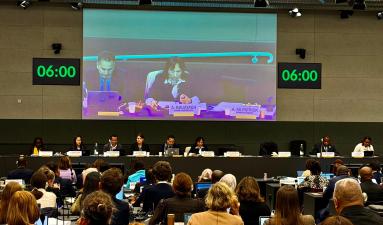
Aware of the impact of rapid digital transformations and technological advances on the effectiveness of rights and freedoms, the Global Alliance of National Human Rights Institutions (GANHRI) approved this afternoon a proposal put forward by its Chairperson, Ms. Amina Bouayach, Chairperson of the National Human Rights Council (CNDH). The proposal calls for a renewed focus, in the coming period, on AI and digital spaces. The proposal calls for a renewed focus in the coming period on AI and digital spaces, and on how they can both challenge and support the protection of human rights.
The GANHRI Office, convening in Tbilisi, Georgia, decided, at the suggestion of Ms. Bouayach, that its annual international meeting in Geneva (March 2026) will focus on AI, digital spaces, and the role of national human rights institutions (NHRIs). This high-level meeting is widely anticipated, reflecting the growing importance of these issues across human rights, legal, ethical, and development fields.
“Digital spaces and AI systems are no longer merely virtual or futuristic technologies; they have become a reality affecting the core of human rights practice,” said Ms. Bouayach. She stressed that NHRIs have a responsibility to strengthen the protection of rights and freedoms in digital spaces and in the era of AI, emphasizing that the impact of these technologies on people’s lives and rights cannot be ignored, nor can the crucial role of NHRIs in protecting and promoting rights. “This includes contributing to the governance of AI systems, from their design to their training, according to a human rights-based and non-discriminatory approach,” she added.
It is important to note that the human rights system is currently facing unprecedented opportunities and challenges due to rapid innovation and technological advancement. AI systems and digital spaces, which have become a new public sphere for expression and social mobilization, now directly affect a wide range of rights and freedoms. These include the right to privacy, freedom of expression, data protection, non-discrimination, access to information, the right to participation, the right to health, the right to education, and children’s rights.
The Geneva 2026 meeting is expected to provide a key platform to highlight both the opportunities and challenges posed by new technologies, while also emphasizing the expanding role of NHRIs. Its aim is to develop a shared roadmap to ensure the effective protection and implementation of human rights at a time when technological innovation is evolving faster than ever before.


Read more